
For companies operating in the United States, cloud migration is a key driver of digital transformation, cost reduction, and operational flexibility. Yet failed migrations are common: costs that come in at twice the original Microsoft Azure estimate, projects that fall behind schedule and disrupt business operations, or systems that simply don’t perform as expected once they go live. Cloud migration isn’t just a technical exercise — it’s a complex initiative that touches strategy, organizational structure, and ongoing operations. This article walks through five common reasons companies fail at cloud migration in the US, along with the keys to getting it right.
Why Cloud Migration Is Harder Than It Looks: 3 Major Challenges
Cloud migration isn’t simply a matter of moving existing systems to the cloud. It’s a project that requires rethinking business processes, organizational structure, and data management — in effect, rebuilding your IT foundation. That’s why so many companies find cloud migration more difficult than expected.
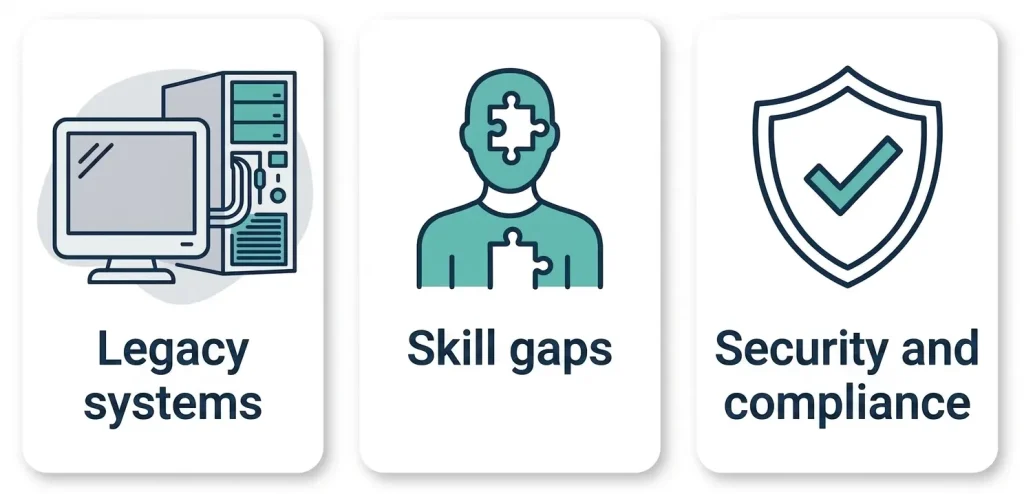
Three challenges tend to create the biggest hurdles:
- Legacy systems: Core systems that have been in use for years often include heavy customization, making a direct lift-and-shift to the cloud difficult or impossible.
- Skill gaps: Cloud architecture requires a different design mindset than on-premises infrastructure, and many internal IT teams aren’t fully equipped to make the shift on their own.
- Security and compliance: Data residency, access control, and an expanding set of regulatory requirements all need to be addressed.
Recognizing upfront that cloud migration is a high-difficulty project is the first step toward a successful outcome.
5 Common Reasons Companies Fail at Cloud Migration
Below are the five most common reasons companies struggle with cloud migration — essential reading if you want to avoid a failed project.
1. No Clear Cloud Migration Strategy — Disconnect Between Business Goals and IT Strategy Drives Up Cost
Many companies begin cloud migration simply because a competitor has already done it, or because they don’t want to fall behind on digital transformation — without a clear strategy in place. Projects without a clear goal often run into delays and rising costs.
When the objective is unclear — is the priority cost reduction, scalability, or supporting global expansion? — it becomes difficult to set priorities. As a result, business goals and IT strategy drift apart, and ROI suffers. Aligning leadership and operational teams on the “why” behind the migration is the critical first step.
2. Underestimating Cloud Migration Cost — Watch for Hidden TCO and Ongoing Expenses
One of the most common cloud migration mistakes is an incomplete cost estimate. Companies that move forward simply assuming “the cloud will be cheaper than on-premises” frequently see budget overruns once the system is live.
Costs that are easily overlooked include monthly run-rate expenses, data transfer fees, storage tier selection, and backup/redundancy costs. Calculating total cost of ownership (TCO) over a 3-5 year horizon is essential to getting cloud migration cost estimates right.
3. Underestimating Data Migration and Data Cleansing
Data migration is where cloud migration projects most often run into trouble. Years of accumulated data typically include duplicates, inconsistent formats, and unnecessary records. Skipping data cleansing before migration is a leading cause of post-migration issues.
4. Gaps in Security and US Regulatory Compliance (HIPAA, CCPA, SOX)
Cloud environments require a fundamentally different approach to security than on-premises infrastructure. Companies that assume “the cloud provider will handle security” often discover gaps in identity management and access control that increase the risk of a data breach.
In the US specifically, compliance requirements vary by industry and state and should be factored into your planning — HIPAA for healthcare data, SOX for internal controls and financial reporting, and CCPA for consumer privacy, among others. Retrofitting compliance after the fact is far more costly and time-consuming than designing for it from the start. Building Zero Trust principles and compliance requirements into the architecture from day one is essential.
5. Choosing the Wrong Cloud Migration Vendor — Technical Skill Isn’t Enough
Vendor selection is one of the biggest factors in whether a cloud migration succeeds or fails. Companies that hand the project to an inexperienced vendor often run into trouble during requirements definition, leading to costly rework.
Watch out in particular for vendors who can demonstrate cloud migration experience but have limited understanding of your business. Technical execution alone isn’t enough if the solution doesn’t fit how your business actually operates. Post-migration support is just as important a selection criterion as the build itself. Rather than choosing on price alone, look for a vendor who understands your industry, your scale, and your company culture.
3 Keys to a Successful Cloud Migration: Choosing Between Azure, AWS, and Google Cloud
Now that we’ve covered the most common failure patterns, here’s the good news: cloud migration succeeds far more often when companies follow the right approach. Here are three keys to getting it right.
- Choose the right cloud platform: Evaluate Microsoft Azure, AWS, and Google Cloud against your specific operational needs. Many companies choose Azure for its tight integration with an existing Microsoft 365 environment.
- Work with an experienced partner: Don’t rely solely on internal resources — bring in a partner with a proven cloud migration track record.
- Design for the long term: Migration isn’t the finish line. Build a plan that extends through ongoing operations and optimization.
Know the common failure patterns, choose the right vendor, and follow the right sequence — that’s the formula for a successful cloud migration.
Cloud Migration Challenges Specific to the US Market: Region Selection, Multilingual Support, and Global System Integration
Companies migrating to the cloud in the United States face challenges specific to this market. With operations often spread across a vast geography, region selection and network design become more complex. Companies with global ambitions also need to design for multilingual support — English and Spanish, among others.
On top of that, regulatory requirements like HIPAA, CCPA, and SOX vary by industry and by state. For companies integrating with existing systems, designing global system connectivity between overseas headquarters and US operations is a major consideration. This is especially true for companies with international operations or partners: language and process differences can raise the difficulty of a US cloud migration significantly, making it essential to work with a vendor that has deep, hands-on expertise.
How JBS USA Can Help With Your Cloud Migration in the US
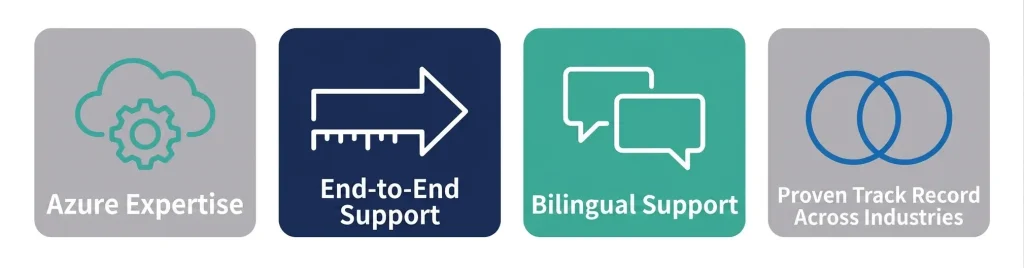
JBS USA is an IT partner with a long track record supporting cloud migration and IT infrastructure projects in the United States. Here’s what we bring to the table:
- Deep Microsoft Azure implementation experience: As a Microsoft partner, we bring proven Azure expertise to customers across the US market.
- End-to-end support from infrastructure design through operations: We support requirements definition, design, migration, and ongoing operations as a single, continuous engagement.
- Bilingual support (Japanese-English): We bridge the gap between overseas headquarters and US operations, both linguistically and culturally.
- A track record across a wide range of industries and company types: Our consulting is grounded in a strong understanding of US business practices.
Summary: Choose the Right Cloud Migration Vendor With JBS USA
A well-defined strategy, sound design, and the right vendor can turn cloud migration into a genuine competitive advantage for your business. Getting there means avoiding the common pitfalls covered in this article: an unclear migration strategy, underestimated costs, neglected data migration, gaps in US regulatory compliance, and the wrong partner selection. If you are considering a cloud migration in the U.S., contact JBS USA, which handles approximately 600 IT-related projects annually. We offer a free initial consultation and will recommend a cloud migration solution tailored to your environment and specific needs.

[Author Bio]
Takumi Hata (Sales Division)
He has extensive experience in IT solution sales, service planning, and application development and operations. Through business expansion initiatives for local governments and customer support, he has been responsible for developing sales strategies and managing projects from planning through execution.